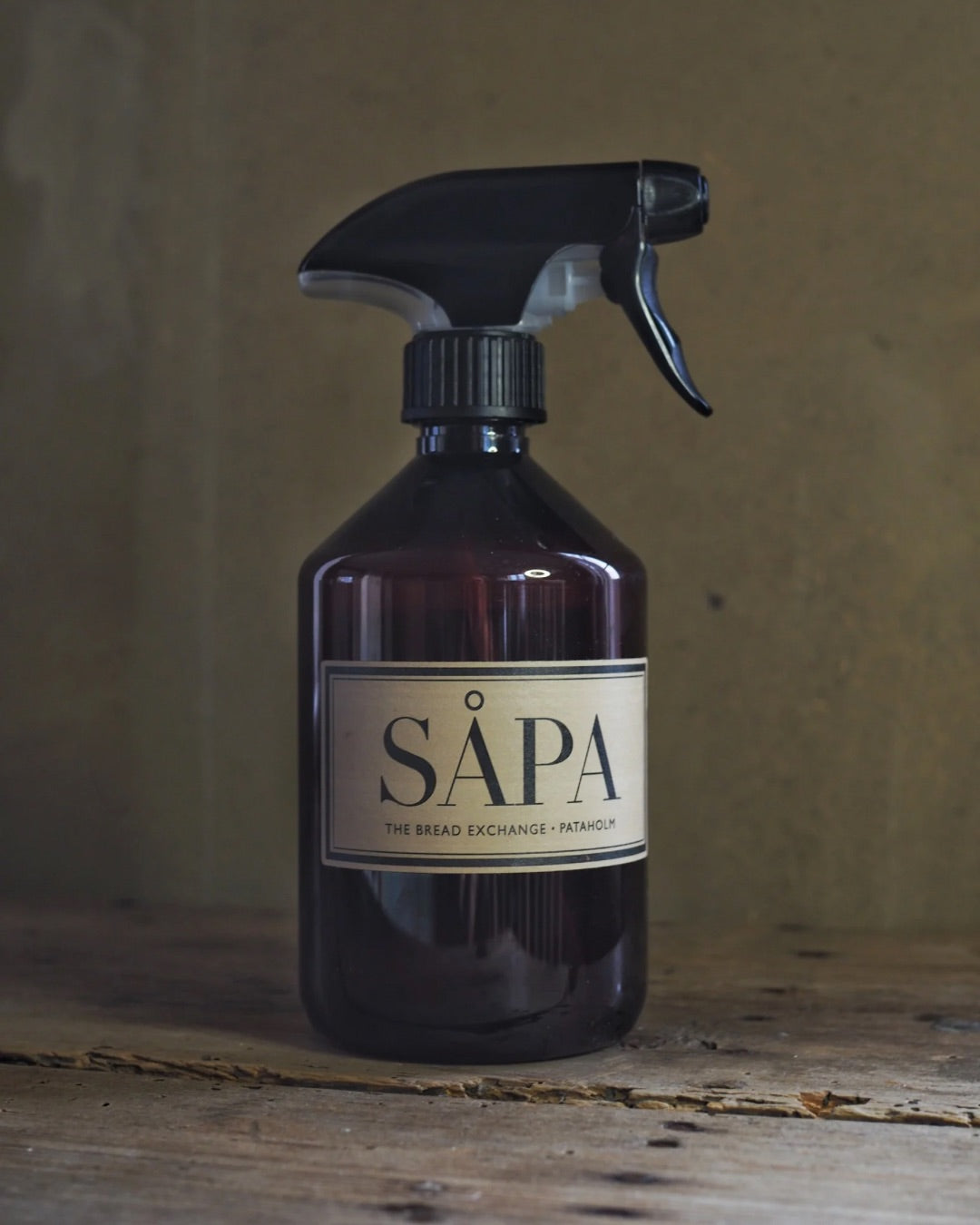
Why PATAHOLM SÅPA works on leather
Leather is a natural material. Its strength and flexibility depend on the oils that remain in the fibers. When these oils are stripped away, the leather becomes dry, stiff, and eventually brittle.

Many modern cleaners are designed to remove grease as efficiently as possible. That works well for synthetic surfaces, but it can be too aggressive for natural materials like leather.
Linseed oil soap behaves differently. It is a true soap, made by saponifying oil. The cleaning molecules are therefore derived from fatty acids rather than petroleum-based surfactants.
Because of this, the cleaning action is gentler. The soap dissolves dirt and grease, but it does not strip the material as completely. In very dilute solutions, a small amount of fatty acids can remain on the surface, helping the leather retain some of its natural suppleness.
This is why traditional soaps have long been used to clean materials such as wood, stone, and leather: they clean effectively while remaining compatible with natural fibers and surfaces.
Two things matter:
1. It cleans, but leaves fatty acids behind. When soap dissolves dirt and grease, it does not completely strip the surface. Because it is made from oils, a very small amount of fatty acids remains on the material.
On leather this has a gentle conditioning effect. Instead of extracting oils aggressively, it cleans while slightly replenishing the surface lipids.
Modern detergents are different. They are designed to remove oil as completely as possible, which is ideal for synthetic materials but harsh on natural ones.
2. Dilution changes the alkalinity
Our Pataholm Såpa has a pH of about 10 in concentrate, which is normal for traditional soaps.
However, pH drops when diluted.
Typical working dilutions bring the effective solution closer to about pH 8–9, which is mild enough for occasional leather cleaning when used sparingly and rinsed.
Historically, saddle makers and shoemakers cleaned leather with very diluted soap solutions for exactly this reason.
Safe dilution for leather
For leather, the key principle is very dilute and minimal moisture.
Recommended starting dilution is 1:200 – 1:300 (about 1 teaspoon per liter of water)
Method:
- Mix soap into lukewarm water.
- Dip a cloth and wring it almost dry.
- Wipe the leather gently.
- Wipe again with a cloth dampened with clean water.
- Let dry naturally.
- If needed, apply a small amount of leather balm afterwards.
Areas of use and care
For regular maintenance, this very dilute solution works well on:
- furniture leather
- bags
- saddlery
- shoes
But for very delicate or vegetable-tanned leather, even milder solutions (1:400+) are sometimes preferred.
Important principles
Never soak leather
Use minimal water
Always wipe off excess soap
Test on a hidden area first
Great care takers for the Bathroom