

USE THE LEAST CLEANER THE MATERIAL NEEDS
With today's blog post, I want to talk about something that is easy to overlook: it makes an insane difference what you use to clean a material.
If you want materials to last and stay beautiful over time, you need to care for them. And one of the simplest ways to do that is to not clean them with something stronger than they actually need.
This applies to everything.
To a wooden floor. To stone. To wool. And to your own skin.
The principle is the same: remove what needs to be removed, and leave the rest alone.
Most modern cleaners are designed to clean very effectively. Often more effectively than necessary for everyday use. We then compensate by giving the material additional care: oiling the floor, waxing the furniture, using conditioners on textiles, applying creams to the skin.
But what if everyday cleaning itself could be part of the care?
Instead of repeatedly stripping a material and then having to restore it, you can choose a cleaner that respects the material in the first place.
This is what I am aiming for.
I want to use the least cleaner I can find on my materials. Not because I don't want things to be clean, but because cleaning should not remove more than necessary.
WOOD, STONE, WOOL
You don't need a different cleaner for every material.
For everyday care, a well-made linseed oil soap can be used on many of the surfaces we live with: wood, stone, ceramic, steel, glass, textiles and more. It cleans effectively, but it does not have to be aggressive to do its job.
And that matters over time.
A wooden floor does not need to be stripped every time you clean it. A wool garment does not need to be treated as if it were a greasy kitchen surface. A stone surface does not benefit from unnecessary harsh cleaning.
The aim is not to clean harder.
It is to clean appropriately.
So for household cleaning, my rule is very simple:
Use the least cleaner the material needs.
Use only as much as needed.
Clean only as often as needed.
Good care is not about stronger cleaners or a separate specialized product for everything. It is about understanding what the material actually needs, and not doing more than that.
And this brings me to the material we all carry around with us every day.
Our own skin.
USE THE LEAST CLEANSER THE SKIN NEEDS
Your skin is not a surface that needs to be stripped clean.
Modern soaps and body washes are often designed for strong cleansing. Many soaps, especially those based heavily on coconut oil, have a high cleansing action. That can be useful when you need to remove heavy grease or dirt.
But for everyday body care, it can simply be more cleansing than necessary.
For me personally, it is usually far too harsh.
Most of us shower regularly. We are not trying to remove layers of dirt and grease from our skin every day. We want to remove sweat, dirt and whatever actually needs to be removed, while disturbing the skin as little as possible.
This is where lard makes sense to me.
Lard is rich in fatty acids that are also found in the lipids of our skin. When used in a well-formulated soap, it produces a soap with a different cleansing profile from a soap based heavily on coconut oil. Here is an older blogpost I made on the benefits of Lard soap.
The goal is not to remove everything.
Your skin has a protective barrier, natural lipids and a living community of microorganisms. These are not dirt. They are part of healthy skin.
The less unnecessarily we disturb them, the better.
And this is really the same idea as using linseed oil soap on wood.
You don't want to strip the wood every time you clean it. You don't want to remove everything from the surface and then have to repair the damage with oil or wax.
You want the everyday cleaning itself to be compatible with the material.
The same goes for skin.
Use the least cleanser the skin needs.
Remove what needs to be removed.
Leave the rest alone.
Clean skin does not have to mean stripped skin.
And good cleaning does not have to mean aggressive cleaning.
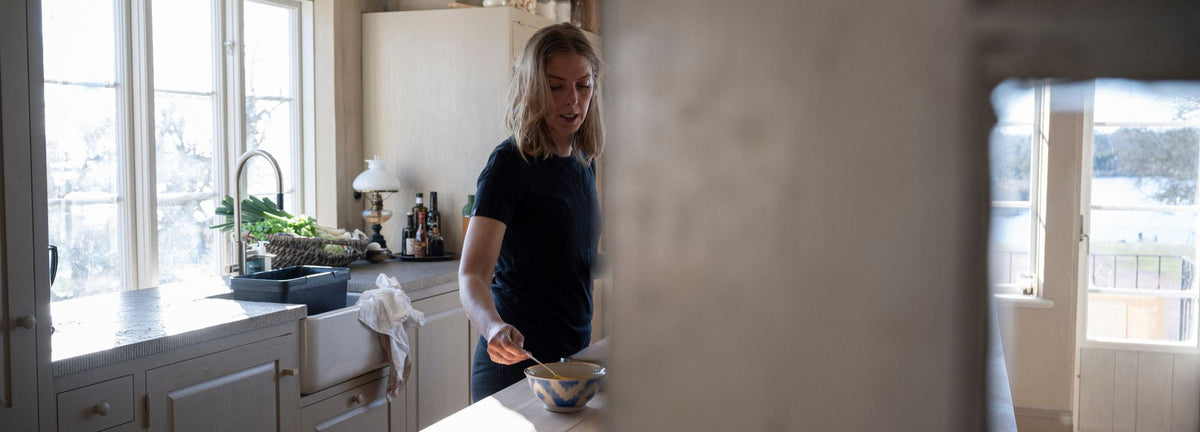
The Image is made by Vanni Jung Ståhle, a photographer from Pataholm.