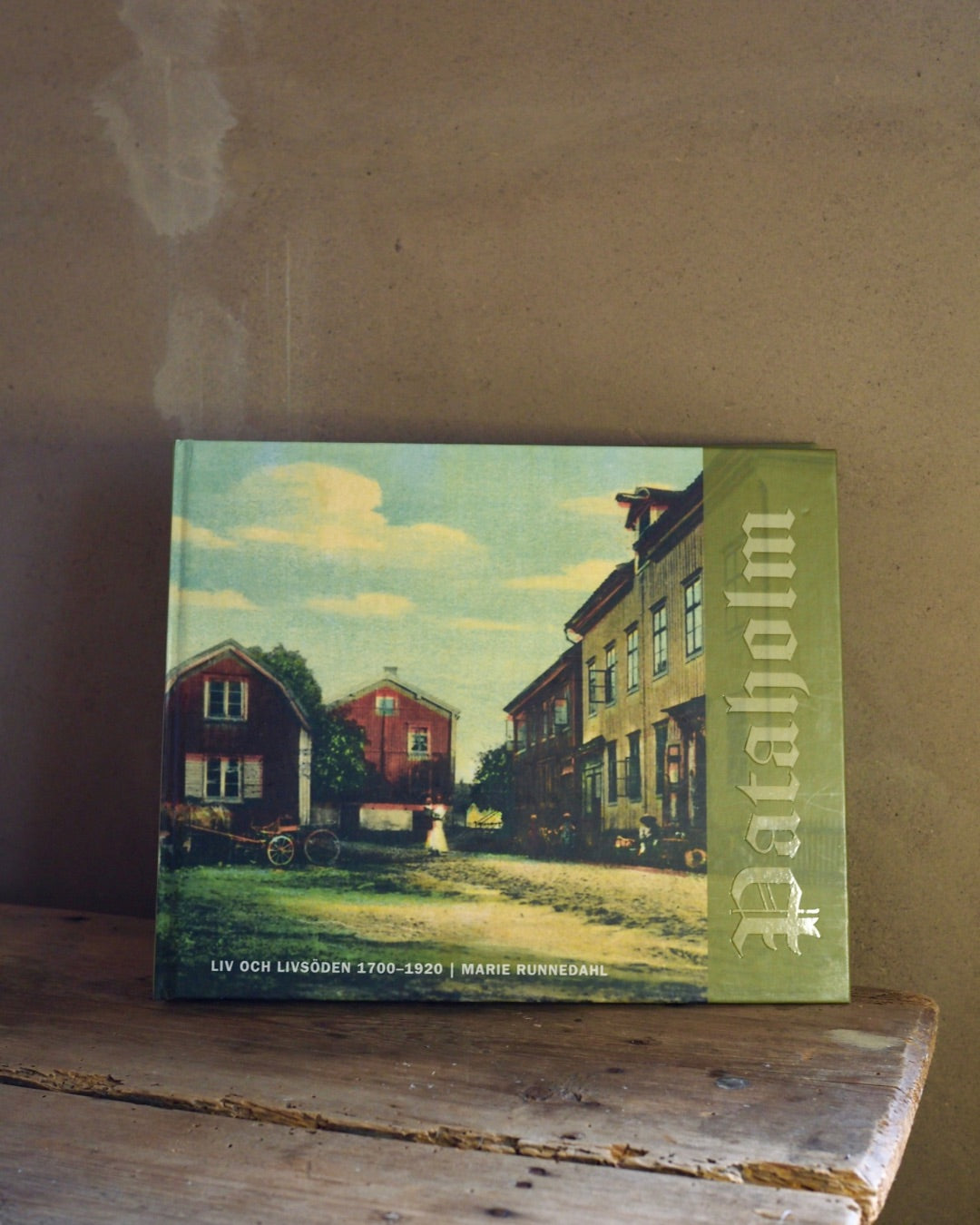
PATAHOLM
LIFE AND LIFE STORIES 1700–1920
Pataholm is a fascinating little community where time seems to have stood still for decades-perhaps even centuries. It’s easy to picture a maid hurrying across the cobblestone square to fill her bucket at the well, or a timber cart rolling past on its way down to the harbor. But what was life really like for the people of Pataholm during the 18th and 19th centuries? Who lived in the beautiful wooden houses? What did they live on-and what did they die from?
Marie's great-great-grandfather was the sea captain Johan Gustaf Petersson. He bought the Hederström estate in Pataholm in 1860, and the house is still in the family today. To understand what life in the market town was like in earlier times, she read countless household examination records, tax registers, deeds, court documents, newspaper articles, estate inventories, advertisements, death and birth records, as well as a large number of letters. I have also been given access to the Ålem local heritage society’s photo archive, along with several private collections and family albums.
In the introductory chapter, you can read about how Pataholm emerged and grew into a thriving subordinate market town where shop boys, hat makers, and tavern keepers mixed with coopers, ship’s captains, and constables. Here you can learn how the townspeople lived, dressed, furnished their homes, and entertained themselves. Many inhabitants died from “water consumption,” tuberculosis, and typhoid fever, but the most common cause of death-aside from infant mortality and old age-was drowning. Life at sea was dangerous, and few people could swim.
The remainder of the book is divided into 26 sections-one for each house. Here you will find answers to who owned the houses, who lived in them, and how their lives unfolded. Many life stories testify to hard and demanding conditions, with large families, young widows, and poverty. But there is also joy, adventure, and deep love. Read about Captain Janne Petersson, who drowned in the wreck of the brig Irma; mason Strandmark’s widow, who had an “illegitimate child” three years after her husband’s death; merchant Hammar, who fell instantly in love during a visit to Kalmar; and boatswain Printz, who was convicted of “drunkenness” and “street fighting.” Among the residents were also the 25-year-old widow Maja, who in 1785 became the tavern keeper of Pataholm’s inn to support her one-year-old daughter; the 21-year-old seaman Carl Sylvin, who fell from the mainmast “while sailing from Ecuador”; and boatswain Jonas Petersson, who in 1868 abandoned his wife and three-year-old daughter to emigrate to America. Living here, too, was the diligent customs inspector Hård af Segerstad, who, among other things, caught captain Renström in the act of sinking 120 cans of spirits outside Pataholm.